
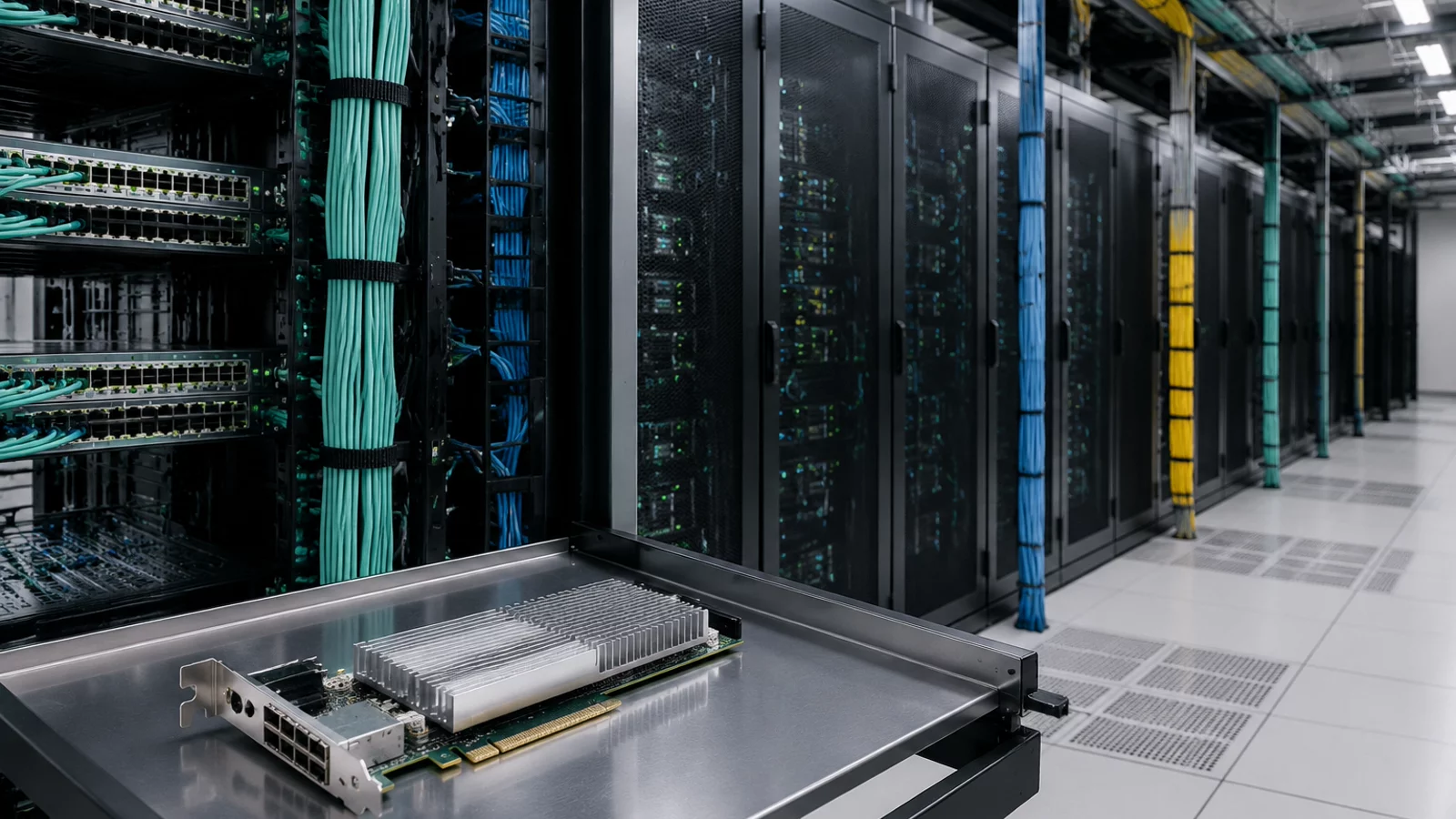
This reference architecture uses NVIDIA BlueField-3 DPUs to separate infrastructure services from host workloads in a secure government data center network. The DPU provides a programmable control point for accelerated networking, storage, and cybersecurity, while redundant switches, independent management, and explicit security zones limit the effect of a compromised or misconfigured server. It is a design pattern, not evidence of compliance or a record of a government deployment. Security accreditation, cryptographic requirements, product certification, and operating procedures remain the responsibility of the project authority.
A secure design cannot be reduced to adding encryption-capable adapters. Government and regulated environments usually need asset separation, identity-based administration, controlled data movement, auditable changes, time synchronization, log retention, and defined recovery procedures. Hardware offload may improve capacity or isolate control functions, but it does not decide policy or prove that a workload is compliant.
Security objectives for the reference design
| Objective | Reference control | Project evidence required |
|---|---|---|
| Infrastructure isolation | BlueField DPU runs selected networking, storage, and security services outside the host CPU domain | Supported mode, software build, administrative boundary, and recovery process |
| Network segmentation | Separate management, application, storage, replication, and security-service paths | Zone matrix, permitted flows, routing ownership, and exception approvals |
| Data in motion | Use supported inline IPsec, TLS, or MACsec functions where the selected part and software support them | Approved algorithms, key custody, certificate lifecycle, throughput, and fail-closed behavior |
| Visibility | Export DPU, adapter, switch, host, and application telemetry to controlled monitoring systems | Log fields, clock source, retention, access policy, and alert response |
| Availability | Two network paths, redundant management, and tested configuration recovery | Failure scenarios, recovery-time objective, spare policy, and restoration records |
Place the DPU at the server trust boundary
NVIDIA describes BlueField-3 as a 400Gb/s infrastructure compute platform with line-rate processing for software-defined networking, storage, and cybersecurity. In this design, the DPU is not simply a faster NIC. It is positioned between each protected server and the data center fabric so selected infrastructure functions can remain separate from the server operating system and its administrators.
The exact services depend on the approved BlueField and DOCA release, host platform, and security architecture. Potential functions include virtual switching, overlay termination, storage transport, policy enforcement, telemetry, and cryptographic processing. Do not enable every available service. Minimize the DPU software footprint, document ownership, and test how the server behaves when the DPU management plane is unavailable.
Use distinct physical and logical zones
A practical topology separates at least the out-of-band management network, workload or tenant network, storage network, backup or replication network, and security tooling. Some projects can carry several zones over a shared physical fabric using virtual routing, VLANs, overlays, and access policy. More sensitive boundaries may require separate equipment selected from the NVIDIA network switch range, adapters, or facilities.
The architecture document should show both. A logical diagram explains permitted flows and enforcement points; a physical diagram identifies actual adapters, switch ports, cable paths, and failure domains. Without both views, a policy can appear isolated while two critical zones still share a single power feed, line card, or management credential.
Select BlueField and ConnectX roles deliberately
BlueField is appropriate where infrastructure isolation and programmable offload are central requirements. A ConnectX adapter may be the simpler choice for systems that need high-performance Ethernet or RoCE but do not require a separate infrastructure-compute domain. NVIDIA lists ConnectX-7 with up to 400Gb/s throughput and hardware acceleration for networking, storage, security, and management; ConnectX-6 Dx supports 25G through 200G Ethernet configurations and inline IPsec and TLS capabilities.
Choose by system role rather than applying one adapter everywhere. Application servers handling sensitive multi-tenant workloads may justify DPUs, while management appliances or fixed-function systems may use conventional NICs. The NVIDIA network adapter catalog is a component starting point, and the ConnectX-7 vs ConnectX-6 Dx guide explains the conventional NIC generation boundary. The approved bill of materials must also state firmware, driver, DOCA version, crypto option, form factor, and server qualification.
Encryption capability is not an encryption design
NVIDIA ConnectX and BlueField platforms include security acceleration, but a project must still choose where encryption begins and ends. Link encryption protects a physical hop. IPsec can protect routed paths. TLS protects application sessions. These controls solve different problems and may be combined, but each adds key-management, observability, and failure-handling requirements.
Confirm that the exact hardware and software combination supports the required mode, cipher, key length, certificate workflow, and performance target. Do not infer certification or regulatory acceptance from the presence of a crypto engine. Where validated cryptographic modules are mandatory, obtain current certificate and configuration evidence for the complete deployed stack.
Keep the management plane independent
BlueField, switches, baseboard controllers, hypervisors, and security tools need a controlled administrative path that does not depend on the workload network. Use separate addressing, strong administrator identity, role separation, and restricted jump hosts. Configuration backups and firmware images should be protected, versioned, and recoverable without relying on the system being repaired.
Decide whether DPU administrators are the network team, platform team, security team, or a jointly controlled role. Unclear ownership creates delayed patching and broad emergency access. Routine tasks, break-glass access, certificate rotation, and hardware replacement should each have an approved procedure.
Build telemetry around questions investigators must answer
Collecting every counter is not the same as useful visibility. At minimum, the monitoring design should help establish which asset communicated, which policy allowed the flow, which software and firmware were active, whether packets were dropped or encrypted, when the configuration changed, and which administrator approved the change.
Synchronize clocks across DPUs, hosts, switches, and log systems. Protect log transport and retention. Test the monitoring path under link failure and high load so the evidence needed during an incident is not the first traffic discarded. Connect security alerts to operational data such as interface errors and congestion; otherwise a physical fault may be mistaken for malicious activity.
Implementation sequence
- Define the data classification, trust zones, permitted flows, and administrative roles before selecting hardware.
- Build a supported server, BlueField, switch, cable, firmware, and DOCA compatibility matrix.
- Deploy management and recovery access first, including configuration backup and controlled software repositories.
- Enable one infrastructure service at a time and verify normal, denied, degraded, and recovery behavior.
- Measure encryption and policy-enforcement capacity with representative packet sizes and concurrent flows.
- Integrate telemetry with the approved monitoring and incident-response platforms.
- Run adversarial, operational, and failure tests before connecting production data.
Acceptance tests for the security boundary
Test positive and negative traffic policy, administrator separation, key rotation, certificate expiry, DPU reboot, host compromise simulation, loss of the management network, switch failure, and restoration from a clean configuration. Measure packet loss, connection recovery, throughput, CPU use, DPU resource use, alert delivery, and log completeness.
For high-availability paths, verify that failover does not bypass inspection or encryption. A faster alternate route is a defect if it crosses the wrong zone. Retest after any firmware, DOCA, operating-system, or switch policy change that affects the enforcement path.
When a DPU-based design is not the right answer
A DPU adds another managed compute domain. For a small, single-purpose environment with modest traffic and no requirement for infrastructure isolation, conventional NICs and well-operated switches may be easier to secure. BlueField is justified when its separation and offload functions address documented risks or capacity needs, and when staff can operate the additional lifecycle.
Questions project teams should answer
Does BlueField-3 make a server zero trust by itself?
No. It can provide an infrastructure control point and support isolation and security services. Zero-trust architecture also requires verified identity, least privilege, policy, telemetry, credential management, software assurance, and continuous operations.
Can existing Ethernet switches be retained?
Possibly. Confirm link rates, transceivers, MTU, routing, segmentation, telemetry, and supported offload modes. A link that comes up does not prove that policy or encryption functions operate as intended.
Should every network be physically separate?
Not necessarily. The decision follows the threat model, assurance level, failure-domain requirements, and operational capability. Logical separation on shared hardware can be valid only when its enforcement and recovery paths are tested.
Reference conclusion: a secure government data center network needs a documented trust boundary, not a security-themed bill of materials. BlueField-3 can move infrastructure services into an isolated, programmable domain, but segmentation, cryptography, administration, telemetry, and acceptance evidence determine whether the resulting system meets the project's security objectives.