
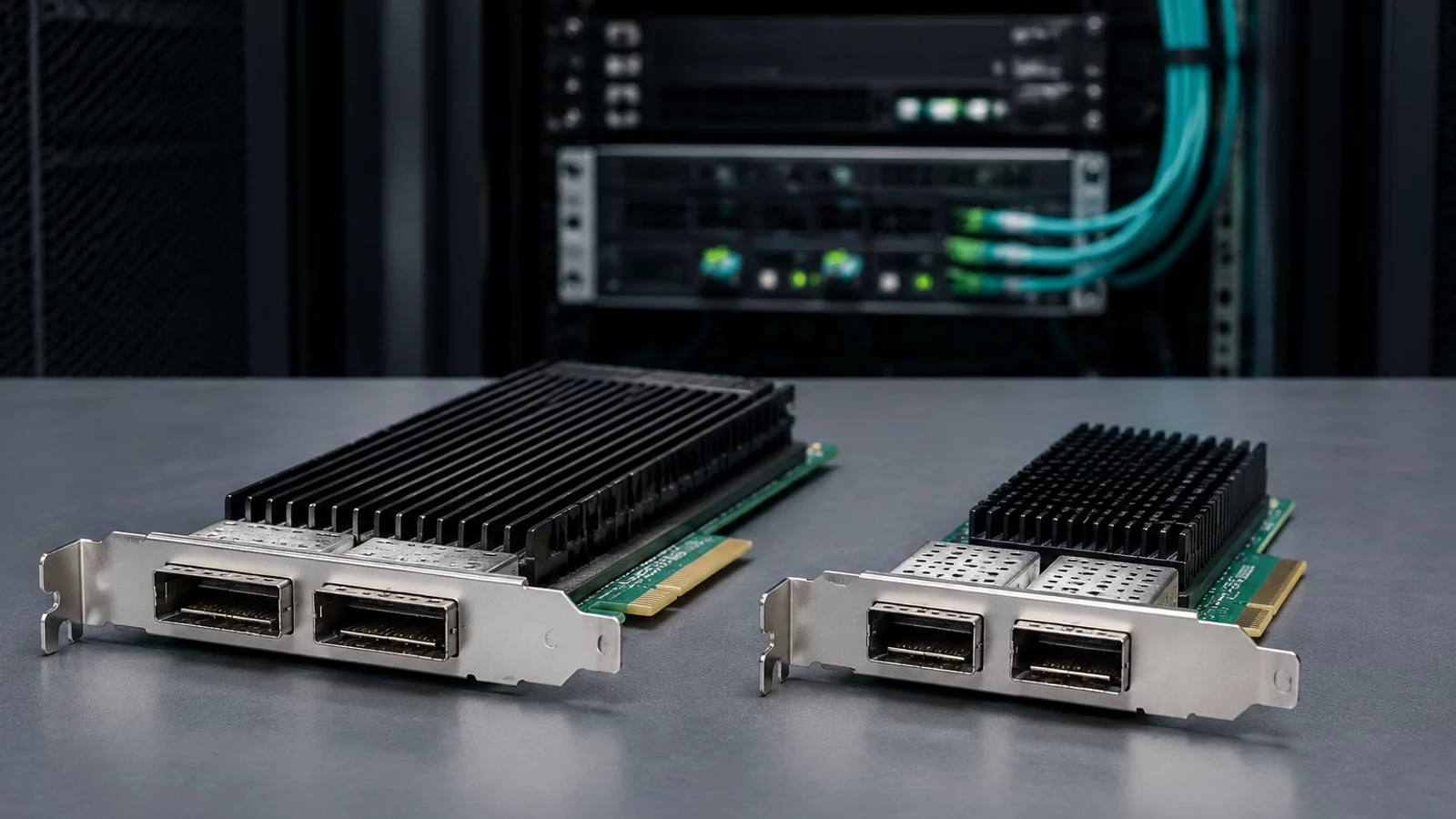
Choose ConnectX-7 when the design requires 400Gb/s connectivity, PCIe Gen5 host bandwidth, NDR InfiniBand, or a clear path to a newer 400G fabric. Choose ConnectX-6 Dx when the requirement is a mature Ethernet deployment at 25, 50, 100, or 200Gb/s and the server platform is built around PCIe Gen4. That is the short answer to a ConnectX-7 vs ConnectX-6 Dx decision. The correct orderable part number still depends on protocol, port count, connector, card form factor, security features, and server support.
A comparison based only on the generation number is likely to produce an expensive mismatch. NVIDIA sells both families in multiple configurations, and two cards carrying the same family name can differ in their supported speeds, port layout, host interface, and physical cage. A procurement team should therefore treat "ConnectX-7" or "ConnectX-6 Dx" as the start of a specification, not as a complete bill-of-materials line.
The practical difference between the two adapter families
| Decision point | ConnectX-7 | ConnectX-6 Dx |
|---|---|---|
| Typical reason to select | 400G fabrics, NDR InfiniBand, PCIe Gen5 servers, or higher-density current-generation Ethernet | Established 25G to 200G Ethernet designs on PCIe Gen4 platforms |
| Maximum family throughput | Up to 400Gb/s; available configurations vary by Ethernet or InfiniBand product | Up to two 25/50/100Gb/s Ethernet ports or one 200Gb/s Ethernet port |
| Host interface | PCIe Gen5 on current high-bandwidth configurations, with exact lane requirements set by the card | PCIe Gen4 |
| Protocol scope | Ethernet and InfiniBand variants are available; protocol capability must be checked by part number | Ethernet, including RoCE acceleration |
| Connector choices | May include OSFP, QSFP112, or other cages depending on the configuration | Connector and port layout vary; 100G and 200G designs commonly use QSFP-family interfaces |
| Best fit | New AI/HPC clusters and servers designed for 400G I/O | Cloud, storage, security, and enterprise data centers standardizing on 100/200GbE |
NVIDIA's current Ethernet adapter overview specifies up to 400Gb/s of throughput for ConnectX-7 and describes ConnectX-6 Dx as a 100/200G Ethernet NIC. The ConnectX-7 InfiniBand data sheet separately lists NDR 400G configurations and PCIe Gen5 support. These are family-level capabilities, not a promise that every SKU exposes the maximum speed or the same protocols.
Start with the server, not the network speed printed on the card
A 400G port does not guarantee 400G of useful application traffic. The host must provide enough PCIe bandwidth, the correct slot wiring, sufficient cooling, a supported firmware and driver combination, and a CPU or GPU I/O path able to feed the adapter. Installing a PCIe Gen5 adapter in an older or electrically narrower slot may reduce the available host bandwidth even when the link comes up at its expected network rate.
Before selecting a card, record the server model, CPU generation, available PCIe slot generation and electrical width, riser restrictions, low-profile or full-height bracket requirement, airflow direction, and operating-system release. For GPU systems, also confirm the intended GPUDirect RDMA topology rather than assuming that every slot has an equivalent path to every accelerator.
Protocol choice changes the comparison
ConnectX-6 Dx is an Ethernet product. It is appropriate for conventional Ethernet, RoCEv2, storage networking, virtualized infrastructure, and security-sensitive data paths that can use the card's hardware offloads. ConnectX-7 spans a broader set of current high-bandwidth deployments, but its Ethernet and InfiniBand configurations are not interchangeable simply because they share a family name.
If the target network is an NVIDIA Quantum NDR InfiniBand fabric, use an InfiniBand-capable ConnectX-7 part number and validate it against the switch speed and cable plan. If the target is a 100/200GbE leaf-spine network, ConnectX-6 Dx may meet the requirement without introducing a new PCIe or optics generation. For a new 400GbE design, compare the appropriate ConnectX-7 Ethernet SKU with the switch platform and planned transceivers.
Port count is a topology decision
A dual-port card is not automatically better than a single-port card. Two ports may support separate fabrics, storage and compute isolation, active-active paths, or a dual-rail AI architecture. They also consume additional switch ports and cables and can increase the number of failure domains that must be operated consistently.
For a single-rail cluster, one correctly sized port may be sufficient. For dual-rail designs, verify that each port has an independent upstream path and that the application stack is configured to use both rails. Connecting two ports to the same failure domain without a clear traffic policy adds equipment but may not add meaningful resilience.
Do not select the cable after the adapter
The adapter cage, switch cage, modulation, lane mapping, protocol, reach, and breakout mode must form one compatible link. ConnectX-7 can appear with OSFP or QSFP112 interfaces in current 400G designs, while switch-side Quantum-2 connectivity uses twin-port OSFP. A cable that is mechanically insertable at one end may still have the wrong lane mapping or intended host type.
Build the interconnect line item at the same time as the adapter. For short in-rack links, a qualified DAC or active copper option may be appropriate. Longer links may require an AOC or matched optical modules and fiber. The NVIDIA Mellanox cable range and Mellanox optical transceiver range should be filtered by the exact host and switch part numbers, not by speed alone.
Where ConnectX-6 Dx remains the sensible choice
ConnectX-6 Dx remains relevant when the deployed network is 100GbE or 200GbE, the servers provide PCIe Gen4, and the operational priority is a stable Ethernet design with RoCE, storage, virtualization, and inline security offloads. Replacing it with a 400G-capable adapter does not improve a fabric whose switch ports, server I/O, or application traffic remain below 200G.
It can also be the more controlled option for incremental expansion. Matching the current adapter generation can simplify firmware qualification, spare holdings, cabling, and observability. The decision should be based on lifecycle and capacity evidence, not on the assumption that the newest NIC always produces the lowest project risk.
Where ConnectX-7 earns its place
ConnectX-7 is the stronger candidate for greenfield 400G networks, NDR InfiniBand, dense AI training systems, and PCIe Gen5 platforms that can use the additional I/O bandwidth. It is also a reasonable choice when the network will start below 400G but the approved architecture and cable plan explicitly include a later 400G transition.
For an example of the current generation, see the ConnectX-7 MCX755106AS-HEAT adapter. Treat the product page as a model-specific starting point and verify the complete ordering code, firmware support, bracket, airflow, and connector against the target server.
A procurement checklist that prevents most mismatches
- Capture the complete NVIDIA ordering part number, not only the ConnectX generation.
- State Ethernet, RoCE, or InfiniBand explicitly.
- Confirm required link speed and whether it applies per port or per adapter.
- Check PCIe generation, electrical width, slot location, bracket, and thermal limits.
- Document single-port, dual-port, or dual-rail intent.
- Match adapter cage to switch cage, lane mapping, cable type, and reach.
- Verify the supported operating system, driver, firmware, and management tooling.
- Define a link and RDMA validation test before accepting the hardware.
Questions buyers often ask
Can ConnectX-7 be used in a PCIe Gen4 server?
Some configurations may negotiate on an older PCIe generation, but compatibility and the resulting bandwidth depend on the exact adapter and server. A link that initializes is not proof that the host path can sustain the intended network rate. Check both vendor support and the server's electrical slot specification.
Does ConnectX-6 Dx support InfiniBand?
No. ConnectX-6 Dx is an Ethernet adapter family. Other ConnectX-6 products exist for InfiniBand or VPI use, so the "Dx" suffix and full part number matter.
Is a 400G adapter necessary for every AI server?
No. The appropriate rate depends on accelerator count, collective communication profile, storage traffic, topology, and oversubscription target. A measured workload and fabric model are better inputs than GPU count alone.
Selection summary: ConnectX-7 is the forward-looking option for 400G, NDR, and PCIe Gen5 designs. ConnectX-6 Dx is a focused Ethernet option for proven 25G to 200G deployments. In both cases, the exact part number and end-to-end link design determine whether the adapter is actually compatible.