
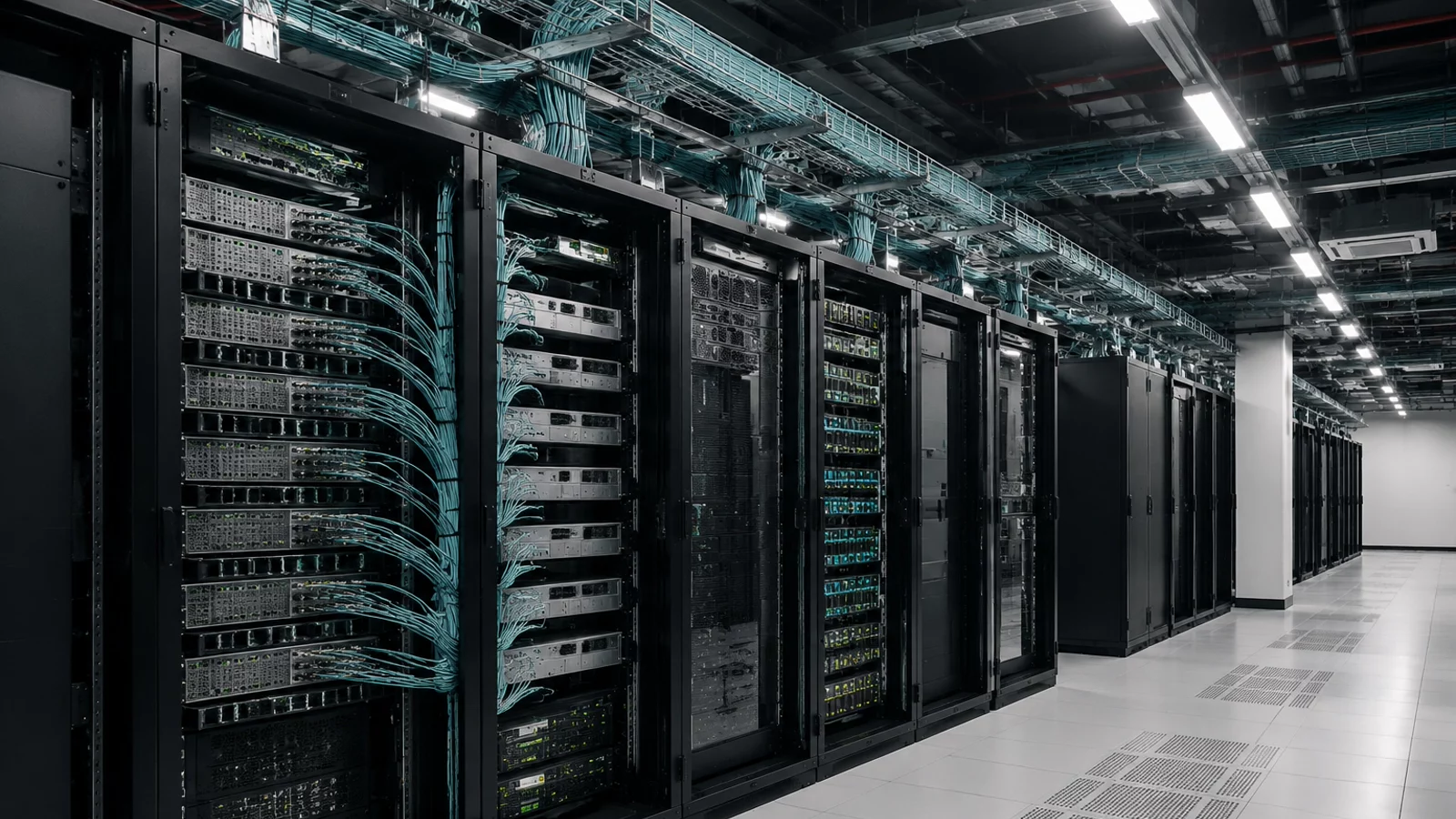
This reference architecture fits an academic HPC environment that needs a dedicated, low-latency fabric for distributed simulation, scientific computing, or GPU-accelerated research. It uses ConnectX-7 adapters at the compute nodes, NVIDIA Quantum-2 switches in a non-blocking or deliberately oversubscribed topology, qualified LinkX interconnects, and UFM for fabric visibility. The design is a planning baseline, not a record of a named university deployment. Node count, rail count, storage traffic, software versions, and acceptance thresholds must be set from the actual research workload.
An academic HPC network design should begin with communication patterns rather than a target link rate. Molecular dynamics, computational fluid dynamics, genomics, climate modeling, and distributed AI training place different pressure on message size, collective frequency, storage access, and synchronization. A 400Gb/s adapter can remove one bottleneck while exposing another in PCIe placement, memory bandwidth, storage, topology, or application scaling.
Design brief and explicit assumptions
| Planning area | Reference assumption | Must be confirmed |
|---|---|---|
| Compute | CPU or GPU nodes running tightly coupled parallel jobs | Node architecture, accelerator count, PCIe topology, NUMA layout, and supported firmware |
| Fabric | NDR InfiniBand with one or two 400Gb/s rails per node | Measured traffic per node, failure-domain policy, and whether both rails are used by the software stack |
| Switching | Quantum-2 leaf-spine fabric sized from endpoint and uplink ports | Oversubscription target, growth reserve, physical port mapping, and management model |
| Storage | Storage traffic is measured separately before sharing the compute fabric | Checkpoint size, metadata load, read/write concurrency, and GPUDirect Storage support |
| Operations | UFM provides discovery, telemetry, validation, and congestion visibility | License level, deployment model, alert routing, retention, and staff ownership |
Why ConnectX-7 and Quantum-2 are paired
NVIDIA documents ConnectX-7 InfiniBand adapters with PCIe Gen4 and Gen5 support and single- or dual-port configurations at up to 400Gb/s. Quantum-2 provides 400Gb/s per port, with 64 logical 400G ports or 128 200G ports in the switch family. Those family-level capabilities make them a coherent NDR generation, but they do not make every adapter, cable, server slot, or switch suffix interchangeable.
The adapter must be selected by full ordering code. Check protocol, port count, OSFP or other cage type, bracket, airflow, crypto option where relevant, and the electrical width of the server slot. The ConnectX-7 MCX75310AAS-NEAT is one model-specific reference, while the QM9700-NS2F shows an internally managed Quantum-2 switch option. Neither product page replaces the server and cable qualification process.
Build the topology from endpoint ports
Count network ports, not servers. A 32-node cluster with one fabric port per node requires 32 endpoint ports. The same cluster with two rails requires 64 endpoint ports and two independent paths. Storage gateways, login nodes, service nodes, and growth reserve add further ports. The leaf allocation determines how many ports remain for spine uplinks and therefore the nominal oversubscription ratio.
For tightly synchronized workloads, a non-blocking fat-tree is the simplest performance baseline. An oversubscribed design may still be appropriate when budget, rack power, or expected traffic supports it, but the ratio must be explicit. Avoid mixing a few heavily loaded leaf switches with lightly loaded ones merely to consume spare ports. The detailed port arithmetic in the QM9700 fabric planning guide can be applied after the endpoint and rail counts are fixed.
Separate rail design from port redundancy
Two connected ports do not automatically create a useful dual-rail fabric. Each rail should have a documented switch path, cable identity, subnet or partition policy, and application configuration. If both ports terminate in the same upstream failure domain, the extra adapter port may increase bandwidth but not provide the intended resilience.
For GPU nodes, map each adapter to the closest CPU socket and accelerator group supported by the platform. Cross-socket traffic can consume host interconnect bandwidth and add variability. Record the PCIe tree for every server model rather than assuming all slots are equivalent. GPUDirect RDMA can provide direct communication between GPUs in remote systems, but it still depends on compatible GPUs, adapters, drivers, CUDA software, PCIe placement, and application libraries.
Use in-network computing only where the workload benefits
Quantum-2 includes SHARPv3 and other in-network computing engines for collective operations. These capabilities can be relevant to MPI and distributed AI workloads, but the benefit is workload- and software-dependent. Confirm support in the selected communication library and compare enabled and disabled runs using the same job placement, message sizes, and process count.
Avoid presenting an acceleration feature as a fixed percentage improvement. Record collective latency, application wall time, scaling efficiency, and switch counters. If the application spends little time in supported collectives, a feature may be functioning correctly without materially changing total job time.
Plan cables with the logical port map
Quantum-2 switches use 32 physical twin-port OSFP cages to expose 64 logical 400G ports. The cable schedule must therefore identify both the physical cage and logical branch. For every link, record switch, cage, logical port, far-end adapter, rail, part number, length, medium, and intended rate.
Short paths may use qualified copper assemblies; longer routes may require active cables or optics. Measure the installed route through managers and trays, include service loops and bend radius, and check that cable bulk does not block fans or adjacent cages. Select items from the NVIDIA Mellanox cable range only after both endpoint part numbers are known.
Keep management and storage decisions visible
UFM Telemetry can capture switch, adapter, and cable telemetry, run system validation, and stream information for analysis. UFM Enterprise adds discovery, provisioning, congestion tracking, reporting, and scheduler integrations. Choose the required level from the operating model rather than treating management software as an accessory added after commissioning.
Storage deserves the same discipline. Measure checkpoint bursts, shared-file-system metadata load, data-staging windows, and concurrent readers. GPUDirect Storage can provide a direct path between supported storage and GPU memory, but it is not a substitute for adequate storage media, controllers, namespace design, or network capacity. If storage shares the compute fabric, define partitions, quality-of-service policy, and failure behavior before production use.
Commission the reference architecture in stages
- Validate every adapter, switch, cable, firmware, driver, and operating-system combination against the approved bill of materials.
- Confirm link rate, width, logical-port identity, subnet management, partitions, routing, and clean error counters.
- Measure point-to-point latency and bandwidth across local and remote leaf paths.
- Run MPI and, where applicable, NCCL collectives across increasing node counts and message sizes.
- Replay storage checkpoints and data-loading traffic together with compute communication.
- Introduce a planned link or switch failure and verify path recovery, job behavior, and alert delivery.
- Save topology, firmware inventory, counters, optical readings, and benchmark distributions as the operating baseline.
Acceptance criteria should be workload-specific
Useful acceptance data includes median and tail latency, achieved bandwidth, collective scaling efficiency, job wall time, packet or symbol errors, congestion events, retransmission where applicable, and recovery time. Test at the intended scale. A two-node bandwidth result cannot validate a multi-rack collective workload.
Repeat key tests after firmware or communication-library changes. Academic environments often evolve rapidly, so the baseline should be reproducible by platform staff and available to research groups when a job behaves differently after an update.
Questions research computing teams should settle
Does every research cluster need 400G per node?
No. Message profile, accelerator count, storage behavior, and parallel efficiency determine useful bandwidth. Some workloads remain limited by compute or memory. Start with traces and scaling tests, then select the link rate.
Should storage use the same InfiniBand fabric?
It can, provided the storage platform supports the design and mixed traffic is modeled and controlled. Separate fabrics may be easier to operate when checkpoint bursts would interfere with tightly synchronized jobs.
Is one QM9700 enough for a small cluster?
One switch can provide many endpoint ports, but it creates a different failure domain from a multi-switch topology and may leave no path for non-disruptive growth. Decide from resilience, rail count, and expansion requirements, not port count alone.
Reference conclusion: a sound academic HPC network design binds each compute endpoint to a documented rail, switch port, cable, management policy, and validation result. ConnectX-7 and Quantum-2 provide an NDR-capable foundation; application traces, server topology, and disciplined operations determine whether that capability becomes repeatable research performance.