
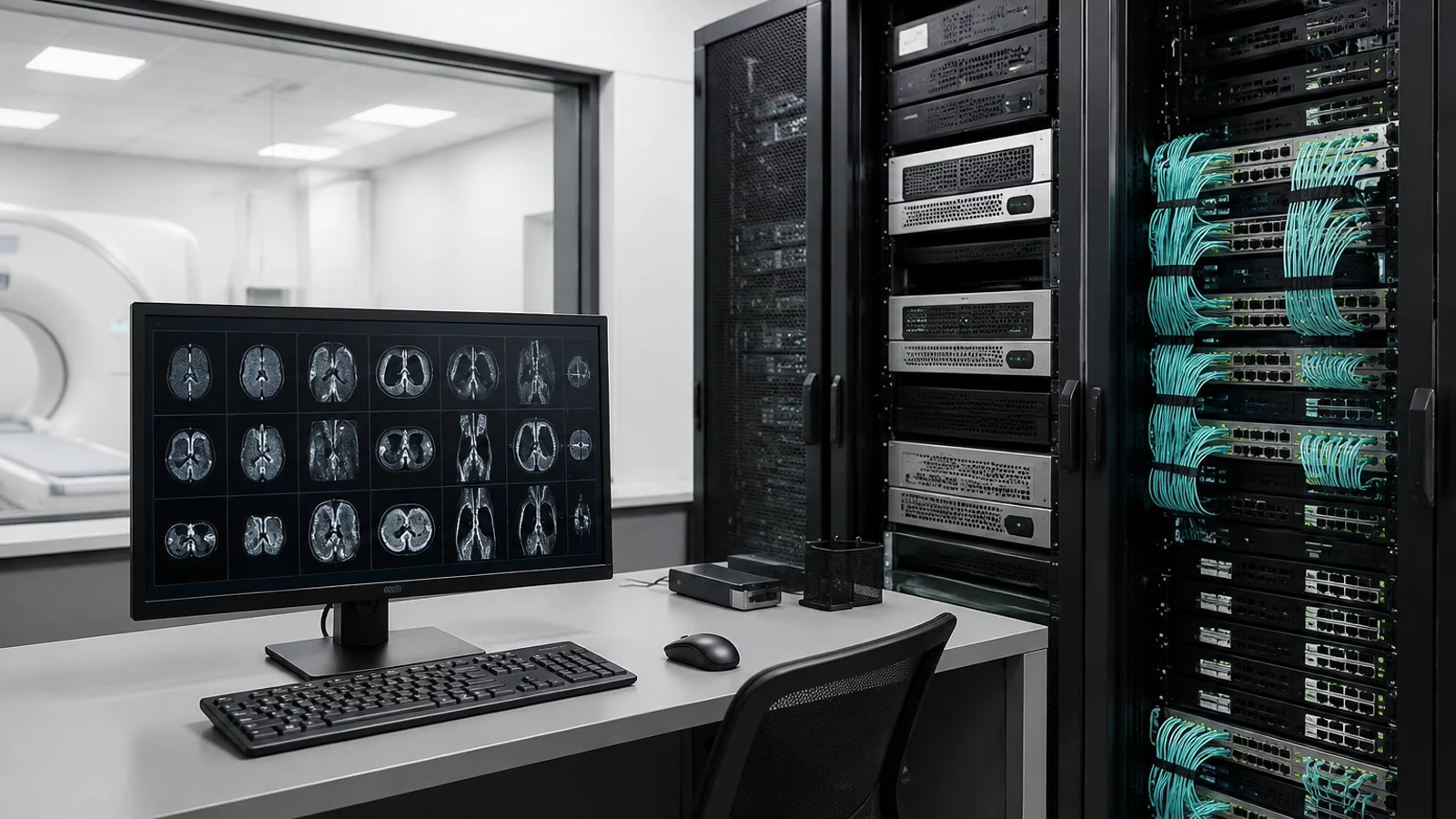
This reference architecture connects medical image archives, preprocessing servers, GPU training or inference nodes, and clinical result systems through a measured high-speed network. ConnectX-7 adapters provide up to 400Gb/s connectivity for supported systems, while GPUDirect RDMA or GPUDirect Storage can reduce unnecessary CPU-memory copies when the complete storage, GPU, adapter, driver, and application stack supports a direct path. The design does not claim a reduction in diagnosis time or improved clinical outcomes. Those results require a validated medical workflow and evidence beyond network performance.
A medical imaging AI network carries several different traffic patterns: large studies moving from an archive, many small metadata operations, GPU-to-GPU exchanges during training, model distribution, inference requests, and result return to clinical systems. Buying a fast NIC for the GPU server addresses only one segment. End-to-end behavior depends on archive throughput, preprocessing, storage metadata, host PCIe placement, fabric congestion, software queues, and the clinical application.
Reference workflow and boundaries
| Workflow stage | Network concern | Evidence to collect |
|---|---|---|
| Archive retrieval | Concurrent large image studies and metadata requests | Study size distribution, read concurrency, archive response, and storage throughput |
| Preprocessing | Temporary data movement between CPU, local storage, and shared storage | CPU use, memory copies, cache behavior, and queue depth |
| GPU training | Distributed collectives plus repeated dataset reads | GPU utilization, collective time, storage stalls, and network counters |
| GPU inference | Tail latency and burst handling | End-to-end p50, p95, and p99 latency under representative concurrency |
| Clinical return path | Reliable, auditable transfer to downstream systems | Delivery confirmation, retries, timestamp consistency, and failure recovery |
Separate clinical, storage, compute, and management traffic
The clinical integration network should not become the uncontrolled east-west fabric for GPU training. Use explicit zones for clinical systems, image archives, AI compute, shared storage, model management, and out-of-band administration. The physical implementation may use separate fabrics or controlled traffic classes on shared switches, depending on assurance and capacity requirements.
Document every boundary where patient data is copied, cached, transformed, or exported. Network segmentation cannot replace application authorization or data governance, but it can restrict which systems can reach the archive and reduce the effect of a compromised compute node. Security logs and application identifiers must remain correlated across these zones.
Choose the GPU data path from measured bottlenecks
NVIDIA GPUDirect is a family of data-movement technologies. GPUDirect RDMA enables supported PCIe devices to access GPU memory for communication between remote systems. GPUDirect Storage creates a direct path between supported local or remote storage and GPU memory, avoiding an extra bounce through CPU memory. These paths can reduce CPU overhead and unnecessary copies, but only when all platform requirements are met.
Start with a trace of the existing workflow. If GPU utilization is low because preprocessing is CPU-bound, a faster network may not help. If storage cannot sustain concurrent reads, direct GPU access may move the bottleneck without removing it. If data is repeatedly decoded or transformed, local caching and pipeline changes may matter more than link rate.
Where ConnectX-7 fits
NVIDIA lists ConnectX-7 Ethernet NICs with up to 400Gb/s throughput, advanced RoCE, GPUDirect Storage, and acceleration for networking, storage, and security. InfiniBand variants can also operate at NDR rates. The protocol decision follows the environment: a dedicated training cluster may use InfiniBand, while an Ethernet-centered medical data center may use RoCE or conventional Ethernet traffic classes.
Select the exact adapter by protocol, port count, connector, PCIe generation and width, crypto option, bracket, airflow, and server support. The ConnectX-7 MCX755106AS-HEAT is a model-specific example, not a universal medical imaging configuration. Validate the server's GPU and PCIe topology so traffic does not cross an unintended CPU socket or constrained riser.
InfiniBand and RoCE require different operations
A dedicated InfiniBand fabric offers an integrated RDMA environment with subnet management, adaptive routing, congestion controls, and in-network capabilities that may suit distributed training. RoCEv2 carries RDMA over Ethernet and can align with existing routed data center operations, but queue mapping, PFC and ECN policy, buffers, routing, NIC settings, and telemetry must be engineered together.
The InfiniBand vs RoCE guide describes these operational differences. Do not choose from peak bandwidth alone. Clinical operations may prefer separation between an AI training fabric and the general hospital network even when both use Ethernet at the physical layer.
Size storage and the network as one pipeline
Record median and large study sizes, daily ingest, reprocessing volume, training dataset size, checkpoint frequency, retention, concurrent jobs, and inference burst rate. From those inputs, calculate sustained and burst throughput for archive, staging, training, and results. Include protocol overhead and enough reserve for degraded operation.
Storage metadata can limit pipelines that read many files even when aggregate link utilization is low. Test representative directory and object layouts. Where optics or active cables are required, bind every link to a qualified adapter, switch, transceiver, fiber type, connector, and reach. Review the Mellanox optical transceiver range only after the host and switch cages are fixed.
Protect sensitive data without inventing compliance
Encryption, segmentation, access control, audit logs, and data minimization should follow the applicable jurisdiction and institutional policy. ConnectX-7 supports hardware-accelerated security functions in selected configurations, and BlueField DPUs can provide an isolated infrastructure domain for networking, storage, and cybersecurity services. Neither product automatically makes an application compliant.
Confirm approved cryptographic modes, key custody, certificate rotation, administrator roles, software patching, and log retention. Use de-identified or approved datasets in performance tests. A synthetic benchmark that contains no patient data is useful for capacity, but it cannot validate the complete clinical control environment.
Commission the pipeline stage by stage
- Establish a baseline with the current archive, preprocessing, compute, and network path.
- Validate adapter, switch, cable, firmware, driver, CUDA, GPUDirect, storage, and application compatibility.
- Measure archive-to-host, host-to-GPU, GPU-to-GPU, and GPU-to-result paths separately.
- Run representative studies and training datasets at normal and peak concurrency.
- Introduce storage, link, switch, and compute-node failures and verify retries and data integrity.
- Confirm that monitoring records end-to-end timing, queueing, errors, and configuration changes.
- Compare the new pipeline with the baseline using distributions, not isolated best runs.
Use operational metrics, not clinical promises
Network acceptance can measure study transfer time, sustained throughput, p95 and p99 inference-path latency, GPU data-starvation time, CPU utilization, collective time, storage queue depth, packet loss, congestion, and recovery time. Clinical outcomes, radiologist productivity, and diagnosis time require separate study design and approval.
Keep both sets of claims distinct. A lower transfer latency may improve technical workflow capacity, but it does not by itself demonstrate a medical benefit. This separation makes procurement decisions more defensible and prevents a benchmark from being presented as clinical evidence.
Questions for medical AI platform teams
Does every inference server need a 400G adapter?
No. The useful rate depends on image size, concurrency, preprocessing, GPU count, model behavior, and storage. Many inference workloads need predictable tail latency more than maximum bulk bandwidth.
Can GPUDirect Storage read from any archive?
No. The storage platform, filesystem or protocol, driver stack, GPU, adapter, and application path must support the configuration. Clinical archive integration may also require staging or transformation before GPU access.
Should training and clinical inference share a fabric?
Only after mixed-load testing shows that training collectives and dataset reads cannot disrupt clinical latency or availability. Separate fabrics or strict capacity and traffic controls may be more appropriate.
Reference conclusion: a medical imaging AI network should be designed as an observable data pipeline from archive to result, with privacy and clinical boundaries kept explicit. NVIDIA networking can reduce data-movement overhead and connect high-throughput GPU systems, but measured workload behavior and validated software support determine the appropriate link rate and architecture.