
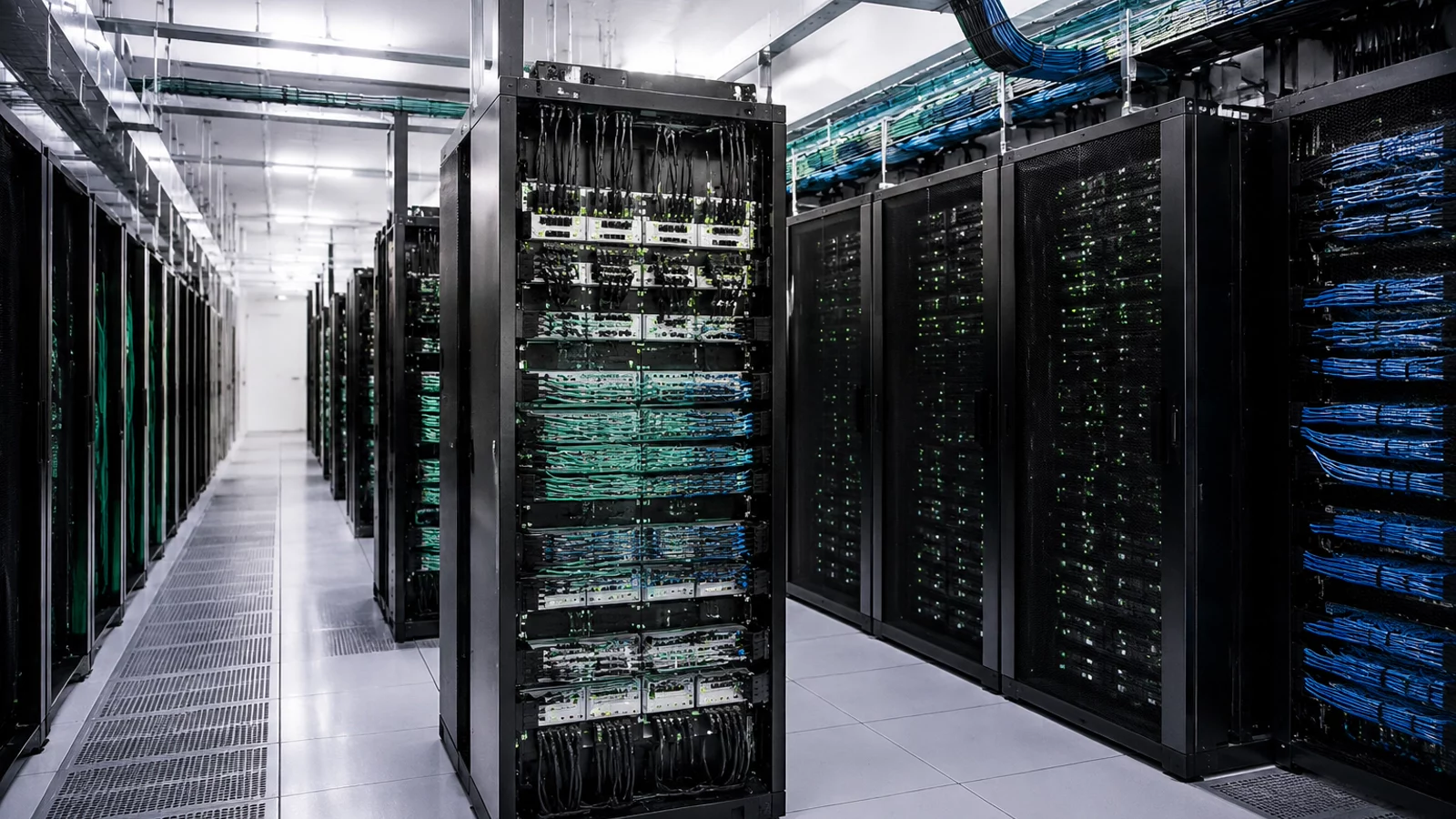
For a dedicated AI training fabric where predictable collective performance and integrated fabric behavior are the priorities, InfiniBand is usually the more direct design. RoCEv2 is often the better fit when the organization needs RDMA on an Ethernet architecture it can operate consistently across compute, storage, and cloud infrastructure. Neither choice is automatically faster in every deployment. The result depends on topology, congestion control, switch and adapter behavior, software integration, and operational discipline.
An InfiniBand vs RoCE comparison is therefore not "specialized network versus ordinary Ethernet." Both NVIDIA Quantum InfiniBand and a correctly engineered RoCE network are hardware-accelerated RDMA fabrics. The difference is where the fabric's control, congestion behavior, routing, and operational complexity are handled.
InfiniBand and RoCE solve the same data-movement problem differently
RDMA allows data to move directly between application memory on different systems with limited CPU involvement. InfiniBand defines an end-to-end RDMA fabric, including its transport, subnet management, routing, quality of service, and congestion capabilities. RoCE carries RDMA over Ethernet. RoCEv2 adds IP and UDP headers, making the traffic routable at Layer 3 and compatible with ECMP-based Ethernet fabrics.
| Design dimension | InfiniBand | RoCEv2 |
|---|---|---|
| Network model | Purpose-built InfiniBand fabric with centralized subnet management | RDMA transport over an IP-routable Ethernet fabric |
| Operational integration | Requires InfiniBand-specific tools and skills | Can align with existing Ethernet routing, automation, and IP operations |
| Congestion behavior | Integrated adaptive routing, congestion control, QoS, and traffic isolation capabilities vary by generation | Requires a deliberately configured lossless or controlled-loss design, commonly using PFC and ECN with consistent queue policy |
| In-network acceleration | NVIDIA Quantum platforms include SHARP and other collective-computing engines | Acceleration depends on the selected Ethernet platform, NIC, and software stack |
| Layer 3 reach | Uses InfiniBand routing and gateway mechanisms | RoCEv2 uses UDP/IP and can traverse IP routers |
| Typical fit | Dedicated HPC and AI fabrics with tightly controlled end-to-end design | Ethernet-centered AI clouds, converged environments, and teams with strong data-center Ethernet operations |
Predictability depends on congestion, not only link speed
Large AI training jobs produce synchronized traffic. Many workers may exchange gradients or parameters at the same time, creating short, intense bursts and incast patterns. A fabric can have enough average bandwidth and still deliver poor job completion time when queues build unevenly or a small number of flows become congested.
NVIDIA Quantum-2 combines NDR bandwidth with adaptive routing, congestion management, performance isolation, and SHARPv3 in-network computing. Those functions are part of the InfiniBand platform rather than a collection of independent Ethernet features that the operator must assemble.
RoCE can also deliver low-latency RDMA, but the Ethernet fabric must be treated as an engineered system. NVIDIA's networking documentation describes PFC as the normal and optimal way to operate RoCE losslessly and states that it must be enabled on endpoints and switches in the flow path. In production designs, ECN, queue mapping, buffer behavior, traffic classes, routing symmetry, and telemetry also need to be validated together. Enabling PFC globally without a queue and congestion plan is not a complete RoCE design.
Operations may decide the architecture before benchmarks do
An organization already running routed leaf-spine Ethernet may prefer RoCEv2 because addressing, ECMP, automation, security boundaries, and observability can fit established practices. That benefit is real only if the network team understands RDMA traffic and can keep NIC, host QoS, switch buffers, PFC, ECN, and routing policy consistent across the fabric.
InfiniBand introduces a separate operating model. Subnet managers, UFM, fabric partitions, InfiniBand counters, and topology-aware troubleshooting require specific skills. The tradeoff is a more integrated environment designed around high-performance messaging and collective communication. For a dedicated AI or research cluster, the separation can reduce ambiguity rather than increase it.
Use the workload communication pattern as an input
Model size and GPU count do not fully describe network demand. Record the framework, collective library, message-size distribution, all-reduce frequency, storage checkpoint behavior, east-west traffic ratio, and tolerance for job-to-job interference. A training environment dominated by synchronized collectives has different requirements from an inference farm with smaller, more independent requests.
InfiniBand's in-network computing can be valuable for collective-heavy HPC and AI workloads. RoCE may be attractive when training shares an Ethernet environment with storage, service traffic, or cloud infrastructure, provided the traffic classes and capacity model keep those workloads from disrupting one another.
Topology and oversubscription still matter
No transport compensates for an undersized topology. A non-blocking fat-tree offers predictable capacity but consumes more switch ports, optics, power, and rack space. Oversubscribed leaf-spine designs reduce cost but need a workload-based oversubscription target and a clear understanding of which flows cross the spine layer.
For either fabric, model endpoint bandwidth, number of rails, leaf downlinks, leaf uplinks, failure domains, and growth reserve. A dual-rail design can improve path diversity, but it doubles the need for consistent cabling and validation. The NVIDIA Mellanox switch catalog and ConnectX adapter catalog should be evaluated as one topology, not as unrelated component lists.
When InfiniBand is usually the cleaner decision
- The cluster is dedicated to AI training, HPC, or tightly coupled scientific workloads.
- Predictable collective communication is more important than sharing the existing Ethernet operating model.
- The design can use a qualified end-to-end adapter, switch, cable, firmware, and management stack.
- The team is prepared to operate InfiniBand subnet management and fabric telemetry.
- SHARP or other Quantum in-network capabilities are part of the application performance plan.
When RoCE is usually the cleaner decision
- The organization requires RDMA while retaining an IP-routed Ethernet architecture.
- Network automation, segmentation, and operational tooling are already standardized on Ethernet.
- The team can validate PFC, ECN, queues, buffers, DSCP or priority mapping, and ECMP behavior end to end.
- Compute, storage, and cloud services need a shared physical platform with controlled traffic classes.
- The selected switches and ConnectX adapters have a supported RoCE design for the required speed.
Validation checkpoints for an InfiniBand fabric
Confirm the fabric generation and link rate, adapter and switch firmware, subnet-manager role, topology, routing algorithm, partition policy, cable and transceiver part numbers, and UFM monitoring plan. Test link health, error counters, path diversity, collective performance, and failure recovery before accepting the cluster. A peak bandwidth test alone does not validate congestion behavior or multi-node scaling.
Validation checkpoints for a RoCE fabric
Confirm RoCEv2 mode, MTU, VLAN and IP design, PFC priorities, ECN thresholds, queue mapping, DSCP or PCP policy, buffer configuration, routing and ECMP behavior, NIC congestion settings, and telemetry. Run tests under mixed and synchronized load, then introduce link and switch failures. Watch for pause propagation, queue buildup, packet loss, retransmission, and outlier job times rather than reporting only average throughput.
Questions that should be settled before procurement
Is RoCE simply a cheaper form of InfiniBand?
No. Cost depends on the existing environment, switch and optics choices, topology, licenses, engineering time, and operational tooling. Reusing Ethernet skills may reduce change, while building and maintaining a lossless RoCE design can add work. Compare complete architectures rather than adapter prices.
Can InfiniBand connect to an Ethernet data center?
Yes, through appropriate gateway and routing systems, but the AI fabric and the general Ethernet network remain distinct architectural domains. Define where storage, management, and application traffic cross that boundary.
Does RoCEv2 require PFC everywhere?
NVIDIA documentation identifies PFC across endpoints and switches in the flow path as the normal lossless configuration. Some modern Ethernet platforms offer additional congestion mechanisms, but any alternative must be validated as a complete supported design rather than assumed from a feature name.
Decision summary: choose InfiniBand for a tightly integrated, dedicated high-performance fabric; choose RoCE when IP/Ethernet integration is a first-order requirement and the team can operate RDMA-aware congestion control consistently. Benchmark the proposed topology with the real workload before treating either answer as final.